Use gzip to compress a file and gunzip to decompress it, adding -k to keep the original. Use tar to pack a directory into one compressed archive. Check the file format and destination before changing important data, then verify the result.
| What you need | Command or tool | Expected result |
|---|---|---|
| Compress one file | gzip file.log | Only file.log.gz |
| Compress and keep the original | gzip -k file.log | Both files remain |
| Decompress a .gz file | gunzip file.log.gz | Only file.log |
| Decompress and keep the archive | gzip -dk file.log.gz | Both files remain |
| Package an entire directory | tar with gzip compression | One .tar.gz archive |
| Produce a ZIP file | ZIP tool | A .zip archive |
Which should you use: gzip, gunzip, tar.gz, or ZIP?

GNU gzip compresses file contents or a data stream. A plain .gz file holds one compressed input. tar collects multiple files and directories into an archive. Combine the two and you get a .tar.gz or .tgz file.
Take three filenames. server.log.gz is a compressed log you can decompress or inspect with gzip tools. backup.tar.gz is a compressed tar archive of file entries, and GNU tar extracts it. submission.zip is a ZIP archive.
If a downloaded file named download.gz refuses to decompress, check its real format with the file utility:
file download.gzThis helps when a server sends a wrongly named download or someone renamed a file without changing its format.
Compress a file and keep the original

For a file named sample.log, run:
gzip sample.loggzip deletes sample.log once it has written sample.log.gz.
To keep the original, add -k. gzip then leaves sample.log next to sample.log.gz:
gzip -k sample.logPractice on a disposable file
mkdir gzip-practice && cd gzip-practice && printf 'INFO started\nERROR example\n' > sample.logCompress with -k and list the directory:
gzip -k sample.log
ls -1
The listing shows both files:
sample.log
sample.log.gz
Decompress a .gz file without discarding the archive
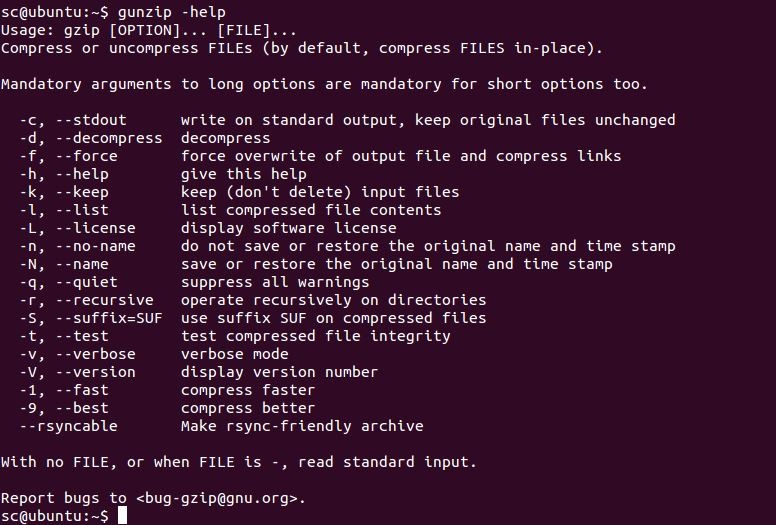
gunzip reverses gzip compression. gzip -d does the same, and -k keeps the compressed input. For sample.log.gz, use one of these:
gunzip sample.log.gzgzip -d sample.log.gzgzip -dk sample.log.gz| Starting state | Command | Files after successful decompression |
|---|---|---|
Only sample.log.gz exists | gunzip sample.log.gz | sample.log |
Only sample.log.gz exists | gzip -d sample.log.gz | sample.log |
Only sample.log.gz exists | gzip -dk sample.log.gz | sample.log and sample.log.gz |
The practice directory above already contains sample.log, so try gzip -dk in a separate folder that holds only the .gz file.
Compress multiple files or a directory: gzip -r vs tar
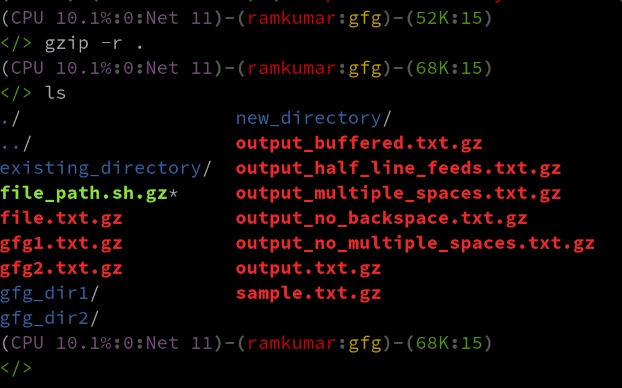
A student working in Lubuntu described the problem in r/linuxquestions: “I then opened the terminal and used gzip -r to compress the directory but instead it compressed every file inside the directory, no the directory itself.”
gzip -r does exactly that. It goes through a directory tree and compresses each eligible file on its own. Take this directory:
reports/
  jan.log
  feb.log
Run:
gzip -r reports/The result is two separately compressed files:
reports/
  jan.log.gz
  feb.log.gz
Create one compressed archive with tar
Starting from a separate original copy of reports/ with the two uncompressed logs, use GNU tar:
tar -czf reports.tar.gz reports/-c creates the archive, -z applies gzip compression, and -f sets the output filename.
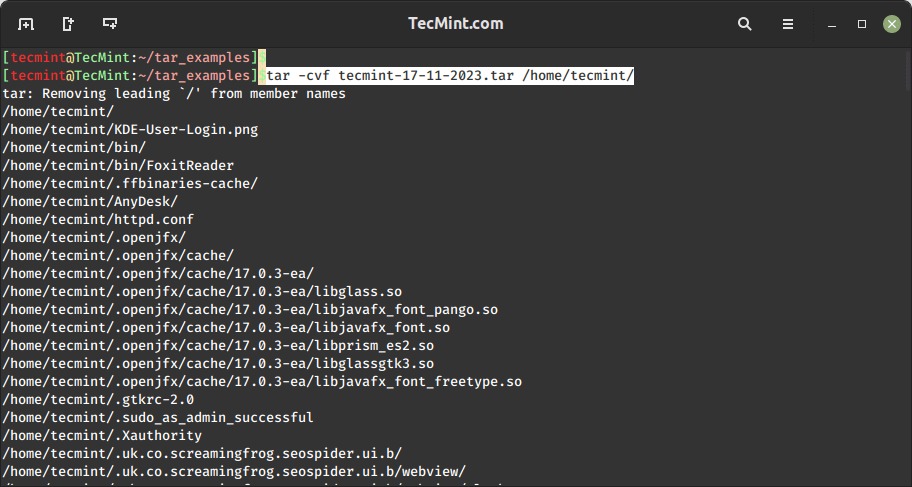
tar packs a directory into one transferable file and leaves the original directory in place. A submission that requires ZIP needs a real ZIP archive, because .tar.gz is a different format. For tar.gz, tar.xz, and extraction, use the procedure to extract tar.gz and tar.xz files safely.
View and search compressed text without extracting it

zgrep 'ERROR' app.log.gz prints matching lines from a compressed log, and no restored copy lands on disk. zless app.log.gz opens the contents for browsing. zcat app.log.gz sends the full decompressed text to standard output. Don't send a very large or binary file through zcat to the terminal, because the output becomes unwieldy or unreadable.
Choose a compression level or write to standard output

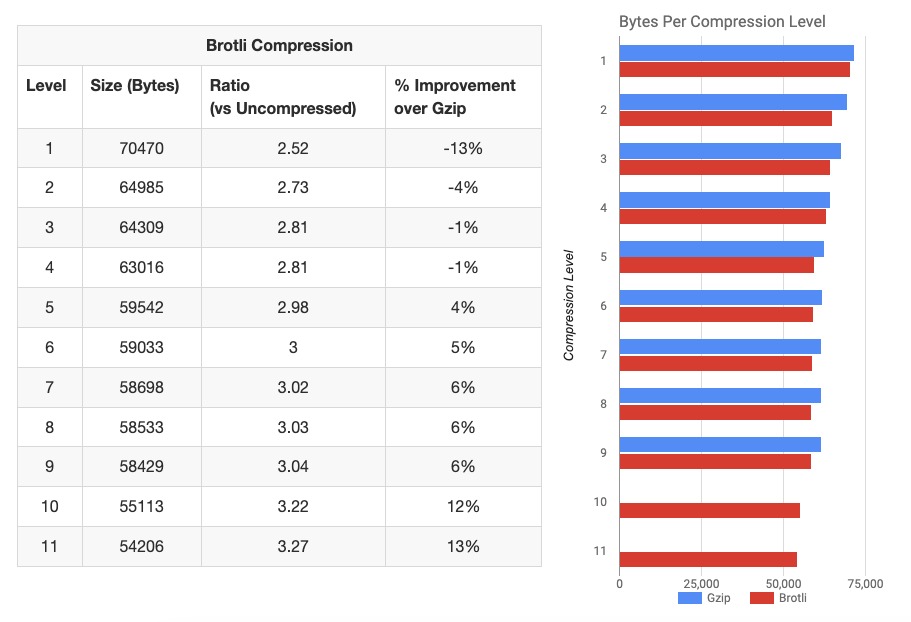
gzip has compression levels that trade effort against output size.
-1: Faster compression.-6: The documented default.-9: More effort for a smaller result.
Data that is already compressed gains little.
To compare levels, run two of them on a representative, noncritical file and write to separate output names:
gzip -1 -c sample.log > speed.gz
gzip -9 -c sample.log > size.gz
sample.log stays in place. Compare the two output sizes.
Send compressed data to a new output filename
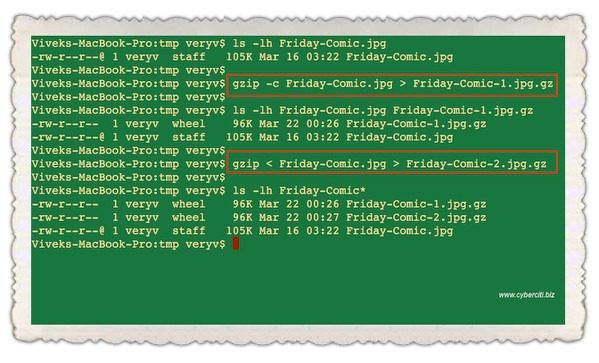
-c writes the output to standard output (stdout), and shell redirection puts it in a file:
gzip -c sample.log > stream-copy.gzThis creates stream-copy.gz and keeps sample.log.
Use a new output filename: The shell's > operator can truncate an existing file before gzip runs, even if your gzip options preserve the input.
Decompress to stdout like this:
gzip -dc sample.log.gz > restored.log-d selects decompression, -c sends the result to stdout, and the shell writes it to restored.log. For work involving Linux commands, shell syntax, and file operations, follow the steps to find Linux commands by task.
Test a .gz file and check the restored data
gzip -t tests the internal consistency of a compressed stream and writes no output file.
gzip -t sample.log.gzA damaged stream triggers an error and a nonzero exit status.
What the gzip integrity check means
The gzip format stores a CRC32 value calculated from the uncompressed data and an ISIZE field with the uncompressed length modulo 232. RFC 1952 defines both.
CRC32 detects errors. A valid gzip stream doesn't prove who produced it.
Compare recovered bytes with a trusted original
If you still have the original sample.log from the disposable exercise, compare it with the decompressed stream:
gzip -dc sample.log.gz | cmp - sample.logcmp reads its first input from standard input when you pass -. A matching result means the bytes it received are identical to those in sample.log. A pipeline reports only the final command's status, so it can hide a gzip error unless pipefail is enabled. Run gzip -t sample.log.gz first, and count the data as verified only when both the test and the comparison succeed.
gzip -l lists information about compressed files. Its uncompressed size is unreliable for very large inputs and concatenated gzip members, so don't treat it as a byte-accurate measurement.
Troubleshoot gzip errors without making the problem worse
| Symptom | Possible cause | First safe diagnostic |
|---|---|---|
not in gzip format | Wrong file type, misleading extension, or a stream already decompressed | Run file on the input, and in a pipeline check which earlier step already decompressed it |
| Destination already exists | The output name matches an existing file | Keep the existing file and check what it contains |
| Corrupt or truncated gzip data | The compressed stream failed its integrity check | Run gzip -t on the file |
| Permission or storage error | The output location isn't writable or is out of space | Check write permission and free space on the output folder |
| Failure after a decompression pipeline | An earlier step already removed the gzip layer | Find which program in the pipeline did the decompression |
| Empty redirected output | The command didn't send the intended data to stdout | Check the -c and -d options |
When a pipeline decompresses gzip twice
“How is the gzipped archive not in gzip format?” a reader asked in r/linuxquestions while troubleshooting a decompression pipeline.
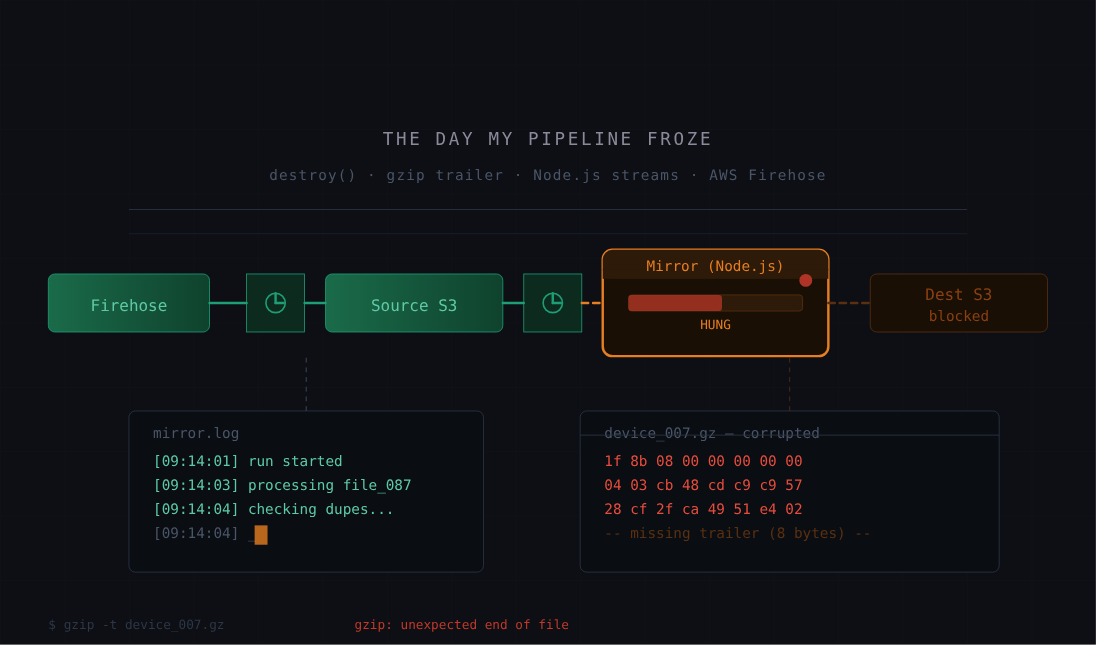
In that pipeline, gunzip -c had already removed the gzip layer before tar tried to decompress the stream again. Once the first step produces a tar stream, a second gzip step fails on it.
If you have a real gzip-compressed tar archive as a regular file, GNU tar handles the compression itself. Extract into a new directory so existing reports/ files stay untouched:
mkdir restored-test && tar -xf reports.tar.gz -C restored-testtar detects the compression, decompresses it, and puts the reports/ tree inside restored-test/.
When the restored filename already exists
Say sample.log.gz should decompress to sample.log, but a file with that name already exists. Keep the existing file until you know whether it holds data you still need.
In an isolated gzip 1.13 test, gzip -dk sample.log.gz encountered an existing sample.log, returned exit status 2, and left that destination unchanged.
Don't use -f to force past an unexplained collision, because it changes overwrite behavior. A truncated download needs another copy. Don't change permissions or delete unrelated files at random to get past a permission or space error.
